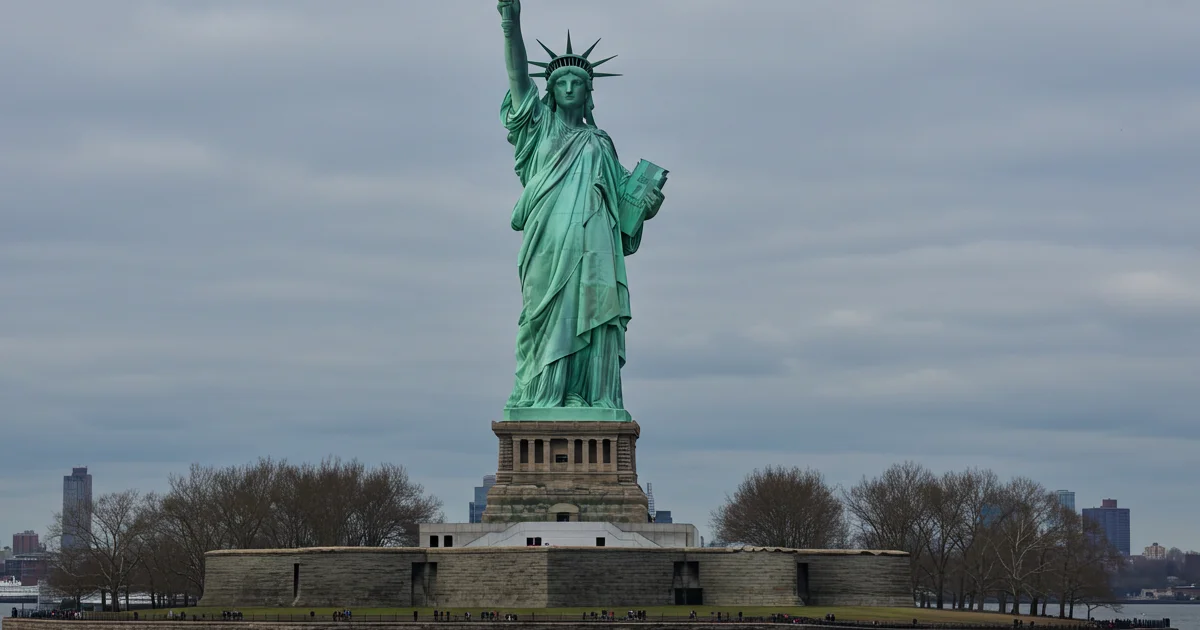
Monument of Liberty
The Statue of Liberty, officially titled 'Liberty Enlightening the World', is a colossal neoclassical sculpture located on Liberty Island in New York Harbor. Designed by French sculptor Frédéric-Auguste Bartholdi and engineered by Gustave Eiffel, the monument stands at 93 meters (305 feet) from the ground to the tip of its torch. Its innovative construction features a thin, hammered copper skin, approximately 2.4 mm (3/32 inch) thick, draped over a robust iron pylon framework, a pioneering technique that influenced modern curtain-wall construction and allowed for its immense scale and structural integrity.
Dedicated on October 28, 1886, the Statue of Liberty was a gift from the people of France to the United States, symbolizing friendship, liberty, and democracy. It quickly became an iconic welcoming beacon for immigrants arriving in America, embodying the ideals of freedom and opportunity. As a UNESCO World Heritage site since 1984, it represents a universal symbol of political liberty and democracy, attracting millions of visitors annually who come to witness its grandeur and reflect on its profound historical and cultural significance.
Attributes
| Year Inscribed | 1984 |
|---|---|
| Property Area | 5 ha |
| Buffer Zone | 0 ha |
| UNESCO ID | 307 |
| Category Type | Cultural |
| Primary Material | Hammered Copper & Iron Frame |
| Epoch Origin | Late Modern Era (1886) |
| Conservation Status | Excellent |
| Annual Visitors | 4.2 million |