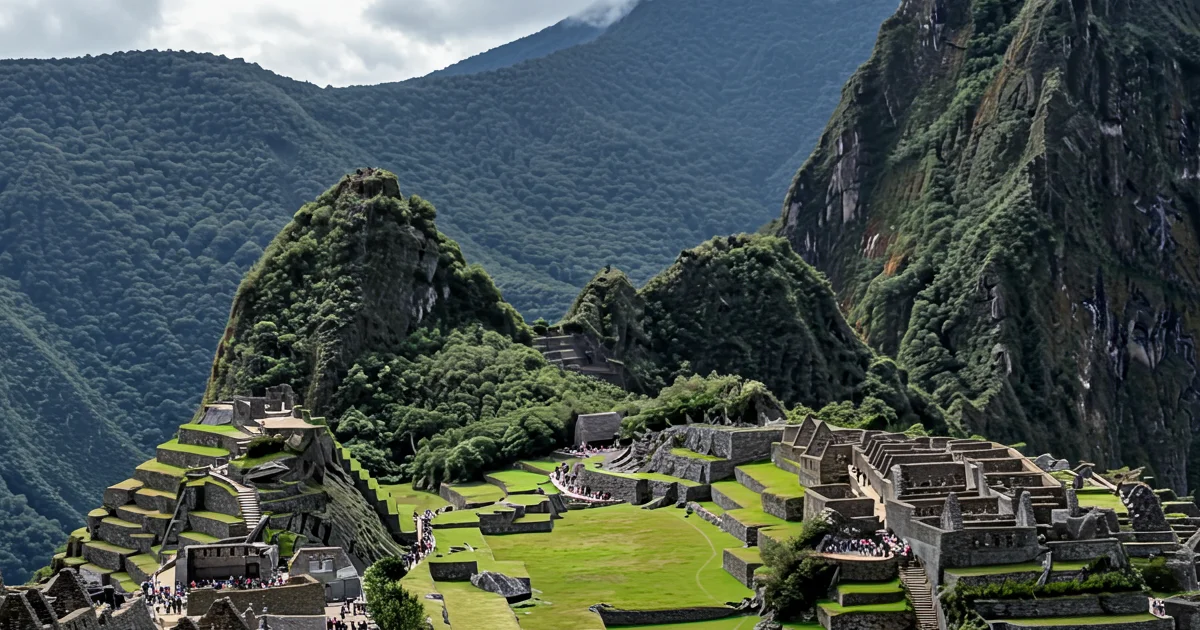
Archeological & Ecological Wonder
Standing 2,430 meters above sea-level, in the midst of an extraordinarily beautiful tropical mountain forest, Machu Picchu was probably the most amazing urban creation of the Inca Empire at its height. Its giant walls, terraces, and ramps seem as if they have been cut naturally in the continuous rock escarpments, showcasing the Incas' unparalleled mastery of dry-stone masonry, where stones are cut precisely to fit together without mortar.
The citadel is broadly divided into an urban sector and an agricultural sector, separated by a wall. Key structures include the Intihuatana (Hitching Post of the Sun), a precisely carved stone thought to be an astronomical clock or calendar; the Temple of the Sun, a curved structure built around a natural rock; and the Room of the Three Windows, which offers panoramic views. These structures, along with over 150 buildings, baths, houses, temples, and sanctuaries, are interconnected by a complex network of stone pathways and over 3,000 steps, reflecting sophisticated urban planning and engineering.
Attributes
| Year Inscribed | 1983 |
|---|---|
| Property Area | 32592 ha |
| Buffer Zone | 40203 ha |
| UNESCO ID | 274 |
| Category Type | Mixed (Cultural & Natural) |
| Primary Material | Granite Ashlar Masonry |
| Epoch Origin | Post-Classic Mesoamerica (15th C.) |
| Conservation Status | Active Monitoring |
| Annual Visitors | 1.5 million |