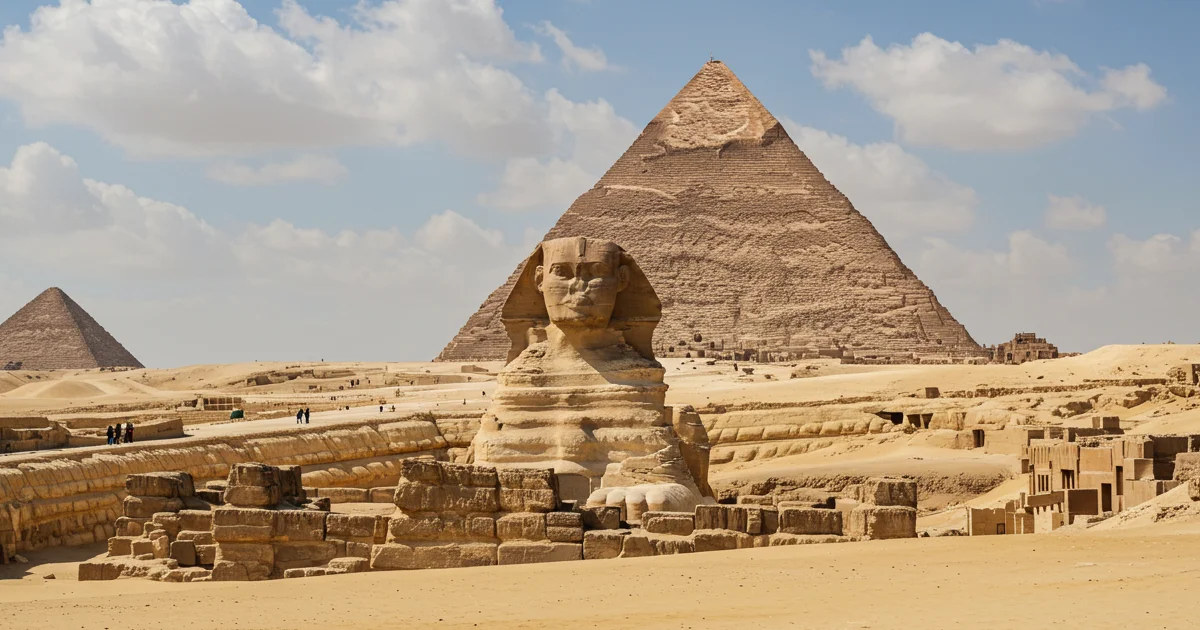
Monument of Antiquity
The Giza Necropolis is dominated by three main pyramids: the Great Pyramid of Khufu, the Pyramid of Khafre, and the Pyramid of Menkaure. The Great Pyramid, originally standing at 146.6 meters (481 feet) tall with a base of 230.3 meters (756 feet) per side, was the tallest man-made structure for over 3,800 years and is the only remaining wonder of the ancient world. Constructed from an estimated 2.3 million stone blocks, averaging 2.5 tons each, its precise alignment to cardinal points and sophisticated internal passages showcase the advanced astronomical and engineering knowledge of the Fourth Dynasty.
Adjacent to the pyramids lies the iconic Great Sphinx, a monolithic limestone statue depicting a mythical creature with the body of a lion and the head of a human, believed to represent Pharaoh Khafre. Measuring approximately 73 meters (240 feet) long and 20 meters (66 feet) high, it is the largest single-stone statue in the world. The entire complex, including subsidiary pyramids, temples, causeways, and numerous mastaba tombs, served as a royal burial ground and a monumental testament to the pharaohs' power and belief in the afterlife during Egypt's Old Kingdom, specifically the Fourth Dynasty (c. 2580–2560 BCE).
Attributes
| Year Inscribed | 1979 |
|---|---|
| Property Area | 161.86 ha |
| Buffer Zone | 0 ha |
| UNESCO ID | 86 |
| Category Type | Cultural |
| Primary Material | Limestone & Granite |
| Epoch Origin | Old Kingdom Antiquity (26th C. BCE) |
| Conservation Status | Active Monitoring |
| Annual Visitors | 8 million |