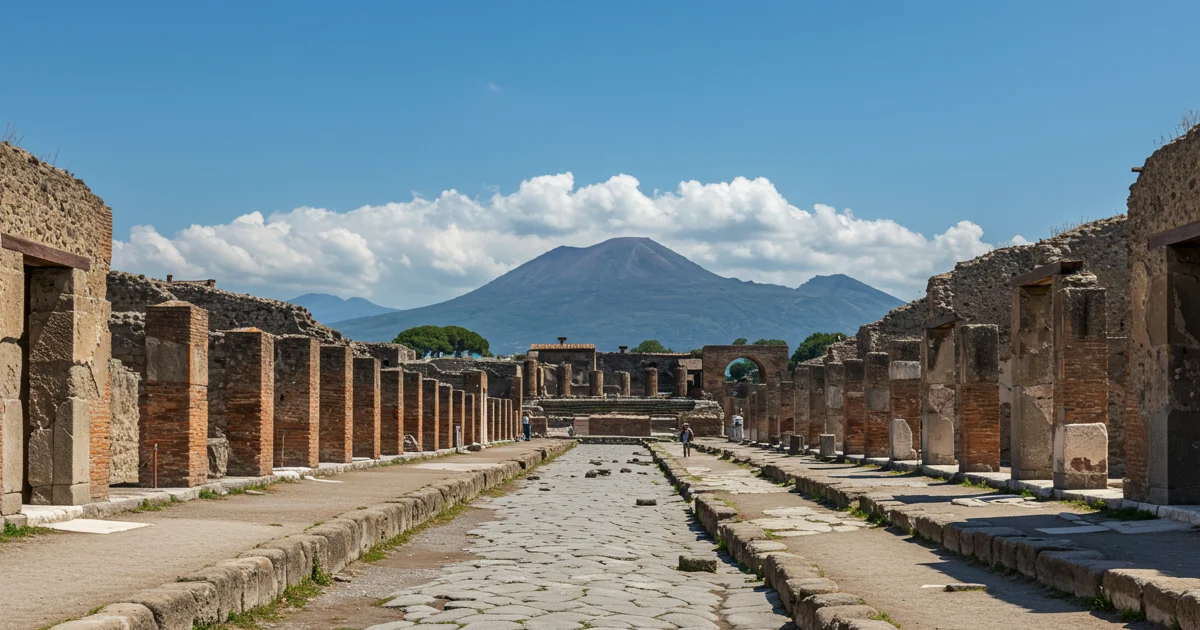
The Buried City of Pompeii
When Mount Vesuvius erupted catastrophically in 79 CE, it entombed the thriving Roman city of Pompeii under meters of volcanic ash and pumice. This sudden and complete burial preserved an unparalleled snapshot of daily life in a Roman commercial center, offering an extraordinary archaeological record. The ash solidified around organic materials, creating voids that, when filled with plaster, revealed the exact forms of victims, animals, and even wooden objects. This unique preservation allows for an intimate understanding of Roman society, from its intricate street layouts and public buildings to private residences adorned with vibrant frescoes and graffiti, providing invaluable insights into the social, economic, and cultural fabric of the 1st century CE.
The archaeological site spans approximately 66 hectares, with about two-thirds already excavated, revealing a meticulously planned urban environment. Key structures include the Forum, the civic heart of the city, flanked by temples, basilicas, and markets; the grand Amphitheatre, one of the oldest surviving Roman amphitheaters, capable of seating 20,000 spectators; and numerous opulent villas like the House of the Vettii and the Villa of the Mysteries, renowned for their elaborate wall paintings depicting mythological scenes and daily rituals. These structures, alongside public baths, bakeries, and workshops, collectively illustrate the sophisticated engineering, artistic prowess, and complex social hierarchy of the Roman world.
Attributes
| Year Inscribed | 1997 |
|---|---|
| Property Area | 98 ha |
| Buffer Zone | 24 ha |
| UNESCO ID | 829 |
| Category Type | Cultural |
| Primary Material | Tuff & Brick Masonry |
| Epoch Origin | Roman Empire Era (1st C. CE) |
| Conservation Status | Active Monitoring |
| Annual Visitors | 4 million |