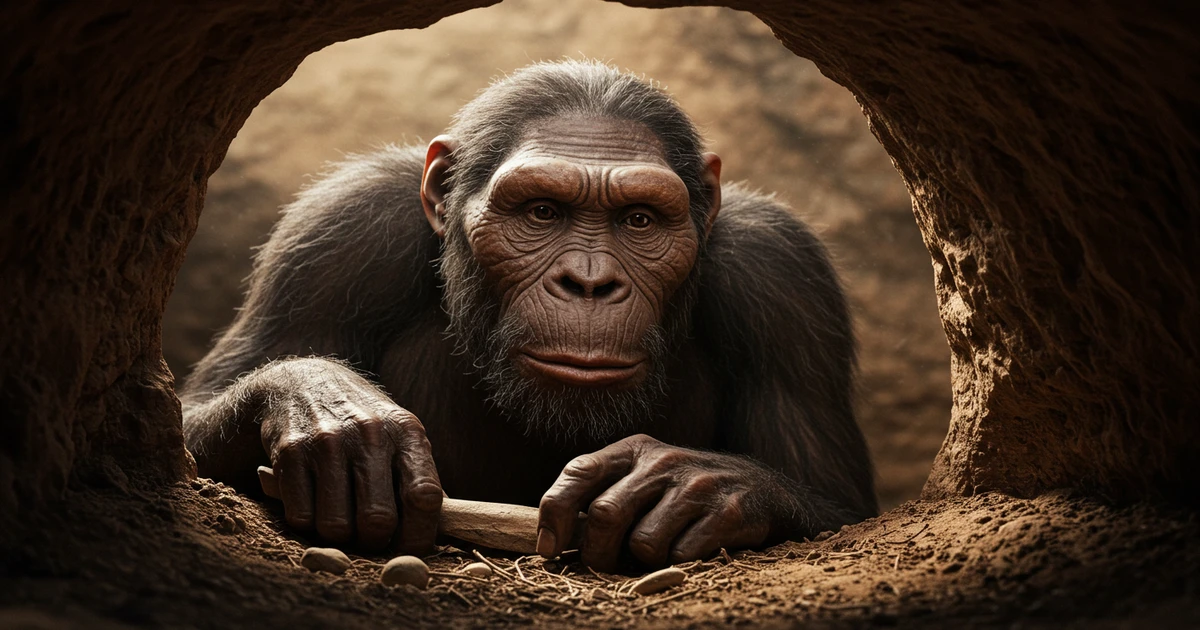
Paranthropus robustus
Paranthropus robustus, meaning 'robust near-man,' was a hominin species that inhabited southern Africa during the Early Pleistocene. Its anatomy is defined by a suite of features related to a powerful masticatory system, earning it the 'robust' designation. This includes a prominent sagittal crest along the midline of the skull (especially in males) for the attachment of massive temporalis muscles, widely flaring zygomatic arches (cheekbones) that created a broad, dish-shaped face, and an exceptionally large mandible. The most telling feature was its megadont dentition, with enormous post-canine teeth (molars and premolars) covered in thick enamel, adapted for crushing and grinding hard, brittle foods. Despite this cranial robusticity, its postcranial skeleton indicates it was a committed biped, with a stature and body mass exhibiting significant sexual dimorphism; males were considerably larger than females.
The paleoecological context of P. robustus is centered on key South African cave sites like Swartkrans, Drimolen, and Kromdraai, which were part of a mixed savanna-woodland environment. Isotopic and dental microwear analyses suggest a diet that was varied but included a significant component of hard objects such as seeds, nuts, or roots and tubers. Intriguingly, bone tools discovered at Drimolen and Swartkrans, showing wear patterns consistent with digging, have been attributed to P. robustus, suggesting a technological capacity for foraging underground storage organs. This species coexisted with early members of the genus Homo, such as Homo habilis or Homo erectus. The eventual extinction of the Paranthropus lineage around 1.2 million years ago is often attributed to increasing climatic instability and potential competitive exclusion by the more adaptable and generalist Homo species.
Attributes
| Year Discovered | 1938 |
|---|---|
| Cranial Capacity | 410 cc |
| Estimated Stature | 1.1 m |
| Type Specimen | TM 1517 |
| Evolutionary Group | Robust Hominin |
| Associated Tools | Bone tools (inferred digging functions) |
| Chronological Range | 2.0 - 1.2 Mya Mya |
| Extinction Context | Extinction ~1.2 Mya, likely due to climate change and competition from genus Homo. |
| Fossil Abundance | Hundreds of specimens |