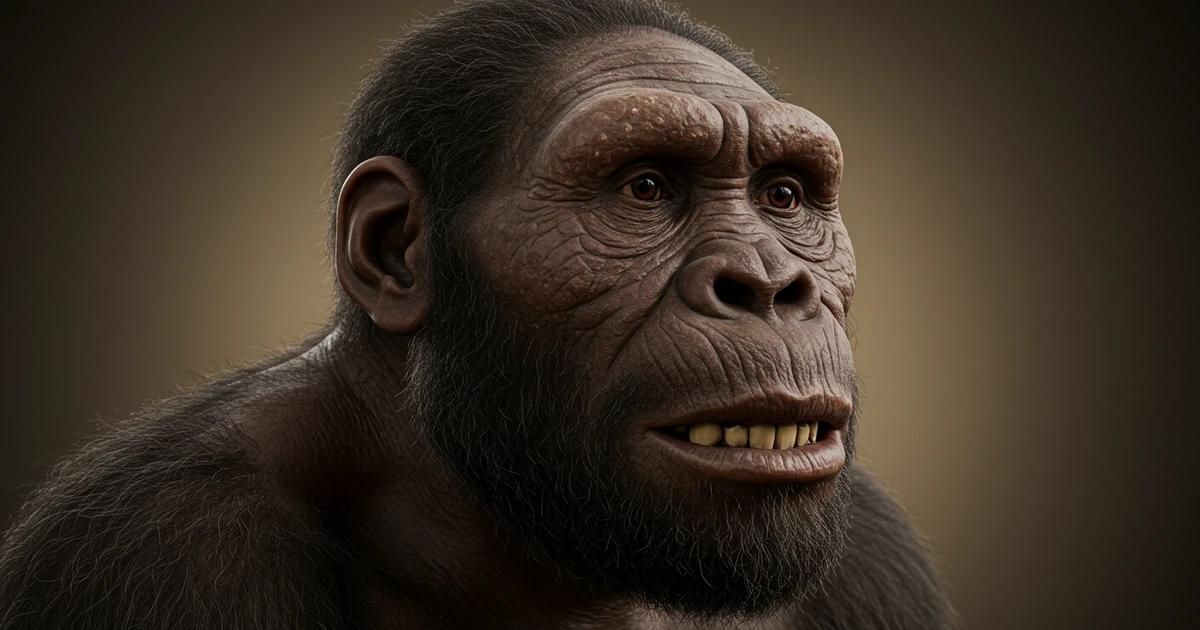
Paleo-Biology and Morphology
Paranthropus boisei is an extinct species of robust australopithecine, first discovered by Mary Leakey in 1959 at Olduvai Gorge, Tanzania. The type specimen, OH 5, was so striking it was nicknamed 'Nutcracker Man' due to its massive jaw and huge molars. This hominin possessed a suite of cranial features adapted for a powerful chewing apparatus, including a wide, dish-shaped face, a prominent sagittal crest in males for anchoring large temporalis muscles, and the thickest tooth enamel of any known hominin. Despite this robust masticatory system, its brain size was relatively small, with a cranial capacity averaging around 510 cc. This morphology points to an extreme dietary specialization, with the skull and teeth built to process tough, low-quality, and abrasive plant foods.
Living across East Africa during the Plio-Pleistocene, P. boisei inhabited savanna-woodland environments. For decades, its powerful jaws were assumed to be for cracking hard nuts and seeds. However, modern isotopic analysis of their tooth enamel reveals a diet surprisingly dominated by C4 plants, such as grasses and sedges, suggesting they were more like hominin lawnmowers than nutcrackers. P. boisei coexisted for about a million years with early members of our own genus, like Homo habilis and Homo erectus. Its extinction around 1.2 million years ago is thought to be a consequence of its extreme dietary specialization, which made it vulnerable to environmental changes and competition from more adaptable, omnivorous hominins.
Attributes
| Year Discovered | 1959 |
|---|---|
| Cranial Capacity | 500 cc |
| Estimated Stature | 1.24 m |
| Type Specimen | OH 5 (Zinj) |
| Evolutionary Group | Robust Hominin |
| Associated Tools | None (found near Oldowan tool sites but not considered the primary maker) |
| Chronological Range | 2.3 - 1.2 Mya Mya |
| Extinction Context | Extinction ~1.2 Mya, likely due to dietary overspecialization and climate change. |