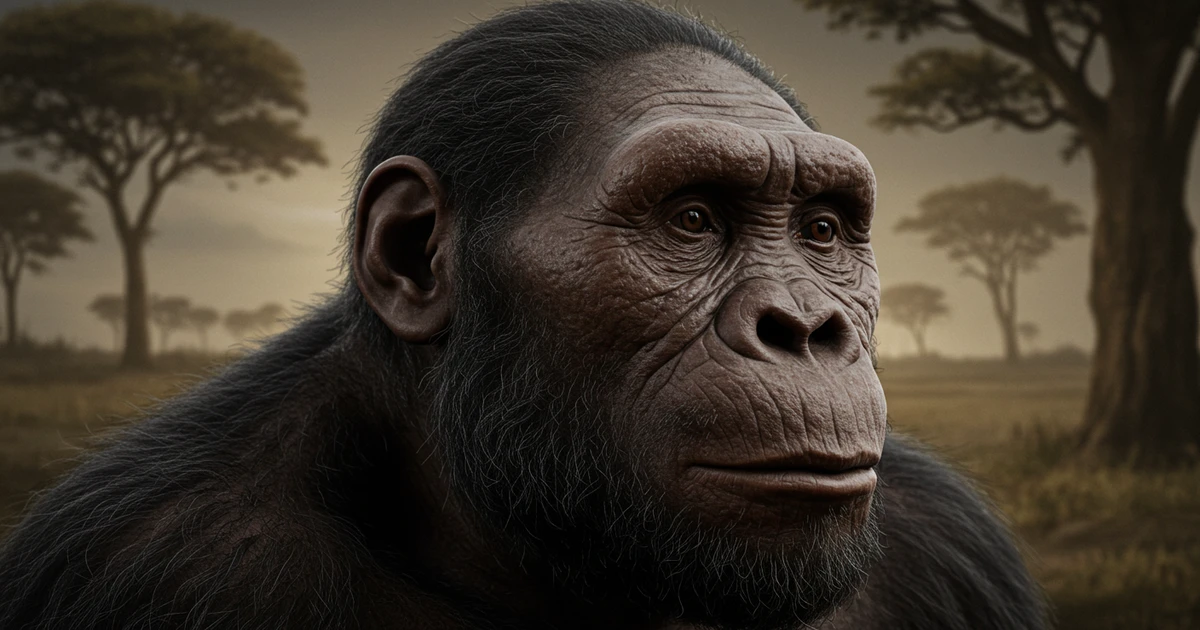
Paleoanthropological Profile
Paranthropus aethiopicus is an extinct species of robust australopithecine that inhabited East Africa between approximately 2.7 and 2.3 million years ago. First identified from a mandible fragment (Omo 18) in Ethiopia in 1967, the species is most famously represented by the "Black Skull" (KNM-WT 17000), discovered in West Turkana, Kenya, in 1985. This remarkably complete cranium, stained black by manganese minerals, showcases a unique mosaic of primitive and derived traits. It possesses ancestral features reminiscent of Australopithecus afarensis, such as a highly prognathic (projecting) face and a small cranial capacity of only about 410 cc. However, these are combined with hyper-robust, derived characteristics like a massive sagittal crest and widely flaring cheekbones, which anchor enormous chewing muscles.
The extreme morphology of P. aethiopicus points to a highly specialized dietary adaptation. The powerful sagittal crest, broad zygomatic arches, and huge, flat post-canine teeth (megadontia) formed a formidable chewing apparatus designed for processing tough, fibrous, and abrasive foods. Isotopic analysis of tooth enamel suggests a diet dominated by C4 plants, such as grasses and sedges, which would have required powerful and sustained grinding. This dietary focus on low-quality vegetation likely confined P. aethiopicus to specific savanna-woodland mosaic habitats. Many researchers consider this species to be the direct ancestor of the later East African robust hominin, Paranthropus boisei, representing an early stage in a lineage defined by extreme masticatory specialization that ultimately proved to be an evolutionary dead end.
Attributes
| Year Discovered | 1967 |
|---|---|
| Cranial Capacity | 410 cc |
| Estimated Stature | Highly speculative (no associated postcranial remains) m |
| Type Specimen | KNM-WT 17000 (The Black Skull) |
| Evolutionary Group | Robust Hominin |
| Associated Tools | None |
| Chronological Range | 2.7 - 2.3 Mya Mya |
| Extinction Context | Extinct ~2.3 Mya; likely replaced by descendant species (P. boisei) or unable to adapt to changing climate and food resources. |