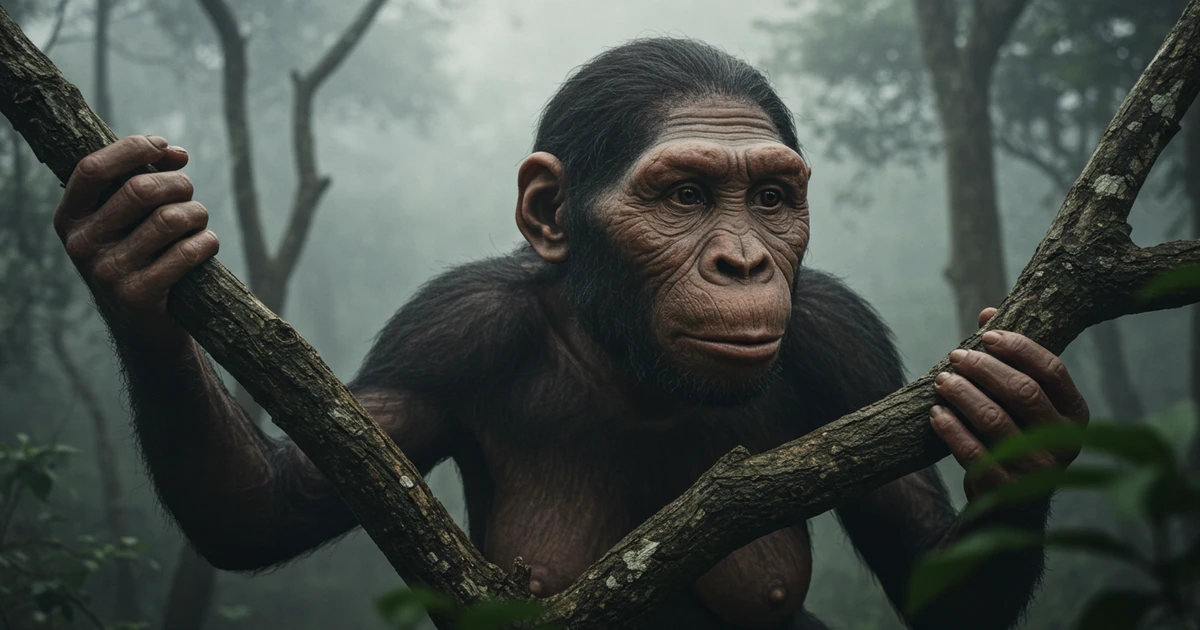
The Millennium Ancestor
Orrorin tugenensis, discovered in 2000 in the Tugen Hills of Kenya, represents a pivotal and contentious species in the study of human origins. The collection of fossils, dating from approximately 6.1 to 5.7 million years ago, consists of at least five individuals and includes crucial postcranial elements like femora, a humerus, and hand phalanges, alongside dental and mandibular fragments. The morphology of the femur, particularly the distribution of cortical bone in the femoral neck, provides strong evidence for habitual bipedalism, a hallmark of the hominin lineage. However, the species also retained clear arboreal adaptations, such as a well-developed brachioradialis muscle insertion on the humerus and curved finger bones, indicating significant time was still spent climbing in trees. This mosaic anatomy suggests a transitional locomotor strategy at the very dawn of human evolution.
The phylogenetic position of Orrorin is a subject of intense scientific debate. Its discoverers, Brigitte Senut and Martin Pickford, have controversially proposed that it is a more direct ancestor to modern humans than the later australopithecines, effectively placing species like Australopithecus afarensis ('Lucy') on a side branch of the human family tree. This argument is based on the femur's modern-like features and its relatively small molars with thick enamel, which contrast with the larger molars of many australopiths. Other paleoanthropologists remain skeptical, suggesting Orrorin could be an ancestor to both australopithecines and Homo, or an extinct side lineage altogether. Its great antiquity places it tantalizingly close to the estimated divergence point of the human and chimpanzee lineages, making it a critical piece of the evolutionary puzzle.
Attributes
| Year Discovered | 2000 |
|---|---|
| Cranial Capacity | Unknown (no cranial fossils) cc |
| Estimated Stature | 1.1 m |
| Type Specimen | BAR 1000'00 |
| Evolutionary Group | Early Hominin |
| Associated Tools | None |
| Chronological Range | 6.1 - 5.7 Mya Mya |
| Extinction Context | Unknown; species likely failed to adapt to changing environments or was outcompeted by later hominins. |