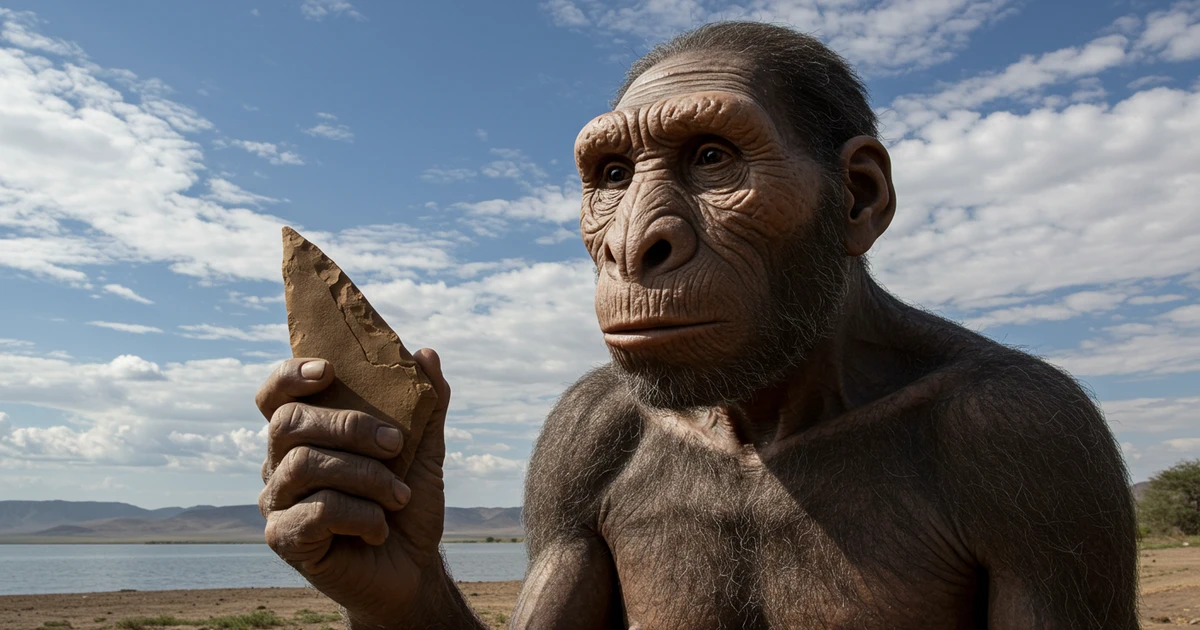
The Working Human
Homo ergaster represents a pivotal shift in hominin evolution, marked by a suite of modern anatomical features. This species possessed long legs and shorter arms, indicating a full commitment to terrestrial bipedalism and the loss of significant arboreal adaptations. This slender, tall physique, exemplified by the famous 'Turkana Boy' skeleton (KNM-WT 15000), was highly efficient for long-distance locomotion across the African savanna, suggesting an active, wide-ranging lifestyle. Cranial capacity saw a notable increase, averaging around 850 cubic centimeters, which is substantially larger than earlier australopiths. The skull also featured a less projecting (prognathic) face, smaller molars, and the development of a prominent external nose, an adaptation thought to help conserve moisture in an arid environment. These changes collectively point to a new adaptive strategy, likely involving increased carnivory and endurance running.
The behavioral complexity of Homo ergaster is most evident in its technological advancements. This species is credited with the development of the Acheulean tool industry, a significant leap from the earlier Oldowan toolkit. Acheulean technology is characterized by large, bifacially worked implements like hand axes and cleavers, which required greater foresight, planning, and skill to manufacture. This advanced toolkit facilitated more effective butchery of large animals, supporting a diet richer in meat and fat, which in turn likely fueled the energetic demands of their larger brains. Many researchers consider H. ergaster to be the African population of Homo erectus and the direct ancestor of later hominins, including Homo heidelbergensis, which eventually gave rise to Homo sapiens. Their evolutionary success allowed them to be the first hominin to expand out of Africa.
Attributes
| Year Discovered | 1975 |
|---|---|
| Cranial Capacity | 600 cc |
| Estimated Stature | 1.6 m |
| Type Specimen | KNM-ER 992 |
| Evolutionary Group | Genus Homo |
| Associated Tools | Acheulean |
| Chronological Range | 1.9 - 1.4 Mya Mya |
| Extinction Context | Likely evolved into later hominins like Homo heidelbergensis, representing a phyletic transition rather than a terminal extinction. |