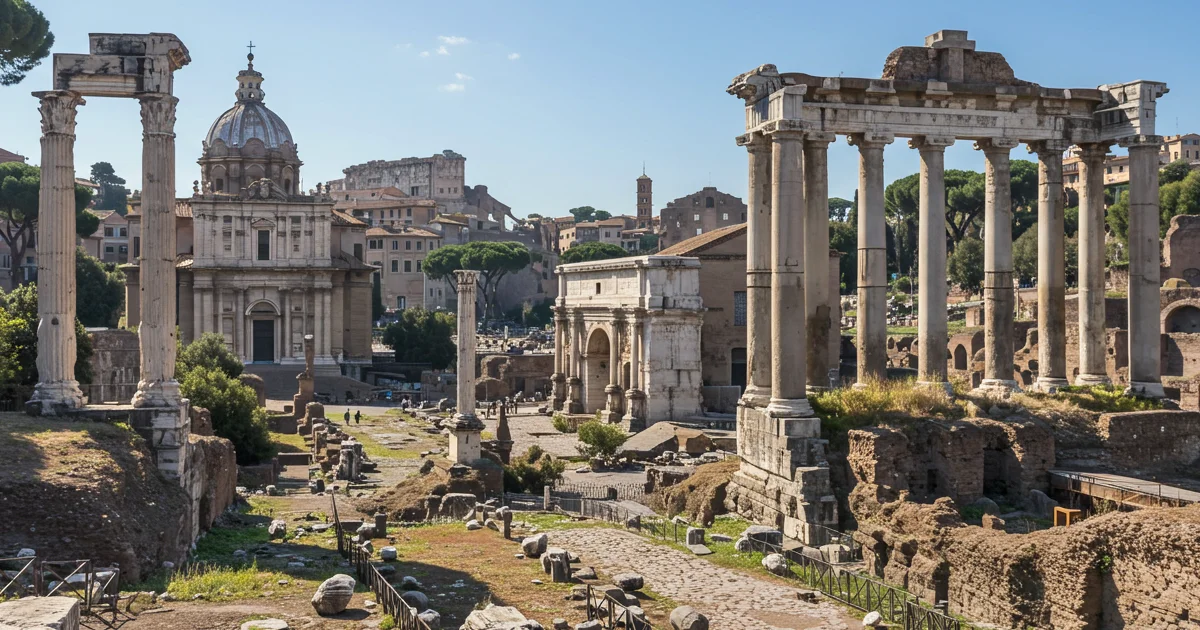
Caput Mundi: The Heart of the Empire
The Historic Centre of Rome, a UNESCO World Heritage site, encompasses an unparalleled concentration of historical and artistic monuments spanning nearly three millennia. Key ancient structures include the Flavian Amphitheatre, famously known as the Colosseum, an elliptical amphitheatre built in 70-82 AD capable of holding 50,000 to 80,000 spectators. Adjacent to it lies the Roman Forum, the heart of ancient Rome's public life, and the Palatine Hill, one of the most ancient parts of the city and site of imperial palaces. The Pantheon, a former Roman temple, now a church, stands as a testament to Roman engineering with its unreinforced concrete dome, the largest in the world for over 1,300 years.
Beyond its ancient core, the Historic Centre integrates significant architectural achievements from the Renaissance and Baroque periods, including numerous churches, palaces, and piazzas. The Vatican City, an independent state within Rome, houses St. Peter's Basilica and the Vatican Museums, which are integral to the site's cultural significance, though technically separate. The urban fabric of Rome showcases a continuous evolution, with layers of history visible in its street plan, fountains like the Trevi Fountain, and iconic squares such as Piazza Navona, reflecting its enduring role as a center of power, religion, and art throughout Western civilization.
Attributes
| Year Inscribed | 1980 |
|---|---|
| Property Area | 1485 ha |
| Buffer Zone | 0 ha |
| UNESCO ID | 91 |
| Category Type | Cultural |
| Primary Material | Travertine & Tuff |
| Epoch Origin | Roman Antiquity (8th C. BCE) |
| Conservation Status | Active Monitoring |
| Annual Visitors | 15 million |