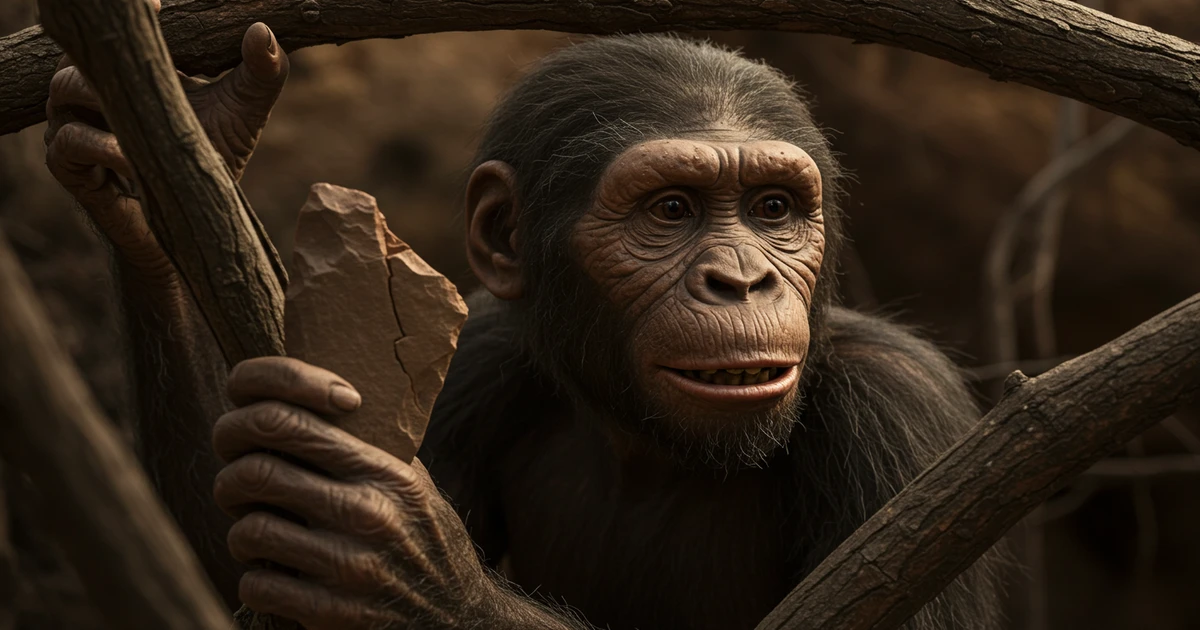
A Mosaic Ancestor
Discovered in 2008 at the Malapa Fossil Site within the Cradle of Humankind, South Africa, by Lee Berger and his son Matthew, Australopithecus sediba has provided unprecedented insight into hominin diversity around two million years ago. The initial finds, a juvenile male (MH1) and an adult female (MH2), were part of a larger assemblage of at least six individuals who appear to have fallen into a natural cave system, a 'death trap,' leading to their exceptional preservation. Dated with high precision to 1.977 million years ago, A. sediba lived at a critical juncture in human evolution. Its anatomy presents a fascinating mosaic, combining features of earlier australopiths with characteristics typically associated with the genus Homo, sparking vigorous debate about whether it represents a direct ancestor to Homo, a sister taxon, or a late-surviving, specialized branch of the australopith lineage.
The species' unique morphology complicates simple classification. Primitive, australopith-like traits include a small cranial capacity (around 420-440 cc), long arms, and an ape-like, funnel-shaped upper thorax adapted for climbing. However, A. sediba also exhibits surprisingly modern, Homo-like features. Its face was less prognathic, and its teeth were smaller than those of other australopiths. The hand is particularly notable, with a long thumb and short fingers suggesting a capacity for a powerful precision grip, potentially for tool use, though no tools have been found in direct association. The pelvis is more human-like, indicating efficient bipedalism, yet the foot and ankle show a unique combination of features suggesting a distinct form of walking with significant hyperpronation, unlike any other known hominin.
Attributes
| Year Discovered | 2008 |
|---|---|
| Cranial Capacity | 420 cc |
| Estimated Stature | 1.15 m |
| Type Specimen | MH1 |
| Evolutionary Group | Australopith |
| Associated Tools | None (hand structure indicates precision grip capable of tool making) |
| Chronological Range | 1.977 - 1.98 Mya Mya |
| Extinction Context | Extinction likely due to competition from early Homo species and environmental changes; represents a lineage that did not persist. |