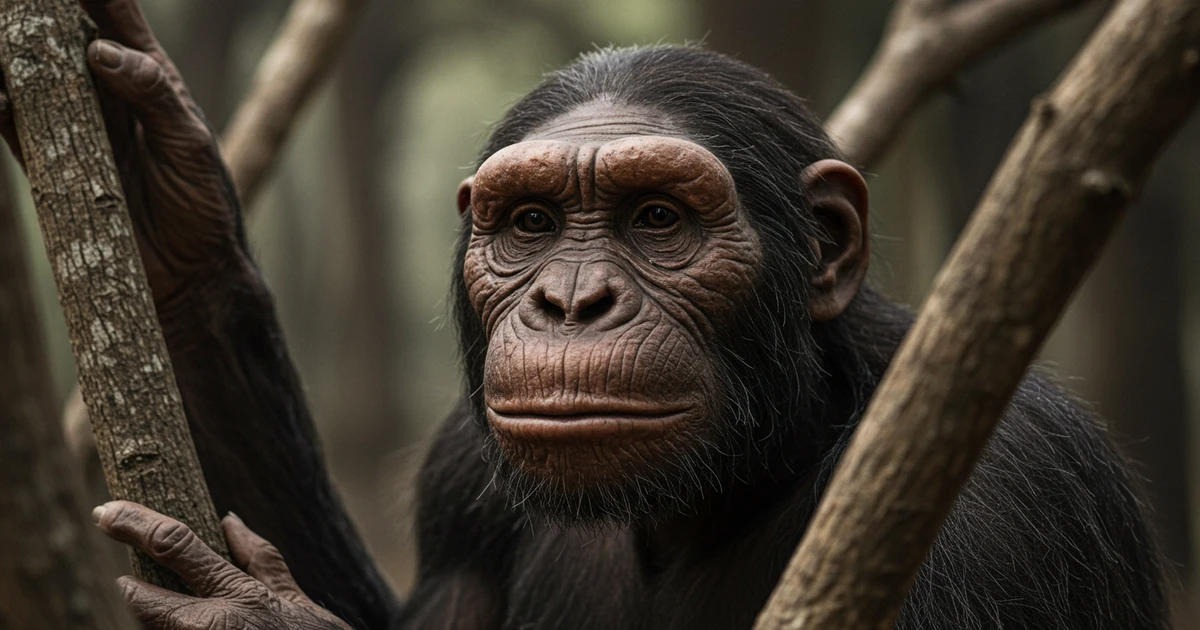
Australopithecus anamensis
Australopithecus anamensis represents one of the earliest and most primitive members of the australopith group, providing a crucial link to earlier hominins. First discovered in 1994 by Meave Leakey's team at Kanapoi and Allia Bay in Kenya, its anatomy showcases a mosaic of ancestral and derived traits. The species is characterized by primitive, ape-like features such as a U-shaped dental arcade with large canines and parallel tooth rows, as well as long forearms. However, the most significant derived feature is the tibia (shin bone), which exhibits a thickened plateau for weight-bearing, providing unequivocal evidence for habitual bipedal locomotion. This combination firmly places A. anamensis as a bipedal hominin that still retained adaptations for arboreal life, and it is widely considered the direct ancestor of the later, more famous Australopithecus afarensis.
The lifestyle of A. anamensis was adapted to a mixed environment of woodlands and open grasslands near lakes and rivers. While its lower limbs were built for walking upright, its powerful arms and curved finger bones suggest it was also an adept climber, likely using trees for foraging, nesting, or escaping predators. Isotopic analysis of tooth enamel reveals a flexible diet, primarily consisting of C3 plants like fruits and leaves, but also incorporating tougher C4 resources such as grasses, sedges, or the animals that ate them. The 2016 discovery of a remarkably complete cranium, MRD-VP-1/1, from Woranso-Mille, Ethiopia, revolutionized our understanding of its face, revealing a projecting midface, prominent cheekbones, and a small braincase of about 370 cc.
Attributes
| Year Discovered | 1994 |
|---|---|
| Cranial Capacity | 370 cc |
| Estimated Stature | 1.3 m |
| Type Specimen | KNM-KP 29281 |
| Evolutionary Group | Australopith |
| Associated Tools | None |
| Chronological Range | 4.2 - 3.8 Mya Mya |
| Extinction Context | Likely evolved directly into Australopithecus afarensis (anagenesis), representing a chronospecies transition. |