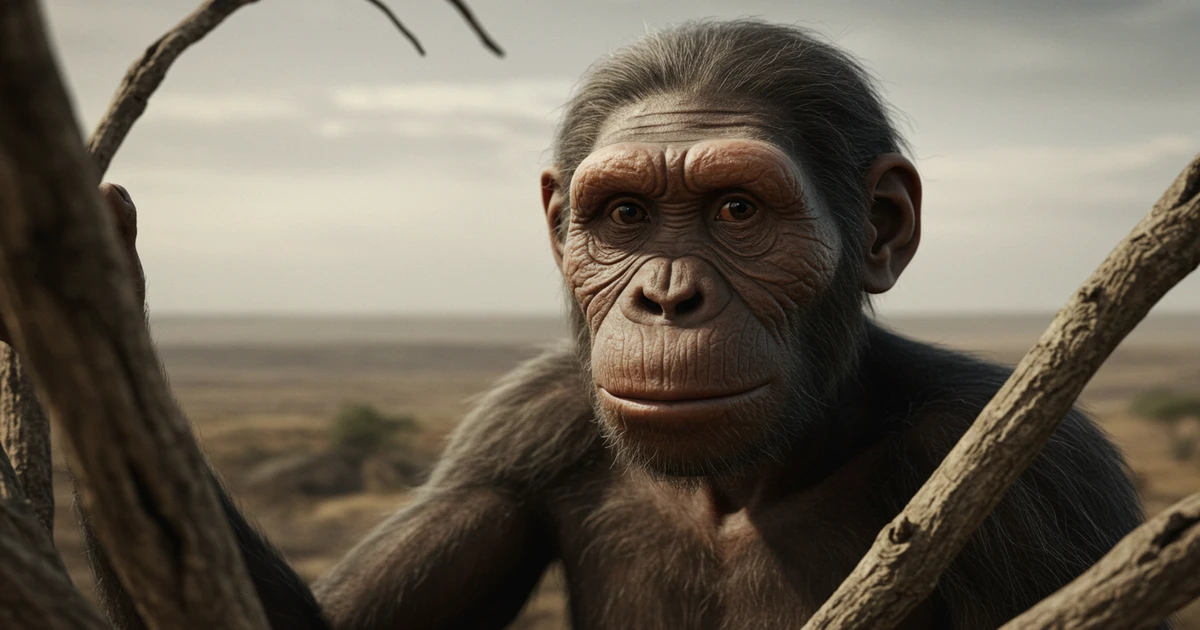
Anatomy and Locomotion
Australopithecus afarensis presents a classic mosaic of ape-like and human-like features, providing a crucial snapshot of hominin evolution. Its postcranial skeleton unequivocally demonstrates habitual bipedalism, evidenced by a broad pelvis, a valgus angle of the knee, and adducted big toes seen in the famous Laetoli footprints. However, it retained significant arboreal adaptations, including relatively long arms compared to its legs, and long, curved finger and toe bones, suggesting it spent considerable time in trees for foraging or safety. The skull was distinctly ape-like, with a small cranial capacity averaging around 420 cc, a strongly prognathic (forward-projecting) face, and prominent brow ridges. Dental characteristics show a reduction in canine size and sexual dimorphism compared to apes, hinting at changing social structures.
This species thrived across East Africa for nearly a million years, inhabiting a mosaic of woodland and savanna environments. Its powerful jaws and large, thickly enameled molars suggest a diet dominated by tough, fibrous plant materials like tubers, seeds, and nuts, though it was likely a versatile omnivore that also consumed fruits and possibly insects. A. afarensis holds a pivotal position in the human family tree, widely considered a direct ancestor of later australopiths and the genus Homo. Its long-lasting success, evidenced by a wide geographic range from Ethiopia to Tanzania and a substantial fossil record, underscores its adaptability before its eventual extinction around 2.9 million years ago, likely due to increasing environmental pressures and competition.
Attributes
| Year Discovered | 1973 |
|---|---|
| Cranial Capacity | 380 cc |
| Estimated Stature | 1 m |
| Type Specimen | AL 288-1 ('Lucy') |
| Evolutionary Group | Australopith |
| Associated Tools | None |
| Chronological Range | 3.9 - 2.9 Mya Mya |
| Extinction Context | Extinction around 2.9 Mya, likely due to climate change and competition from emerging Paranthropus and Homo lineages. |