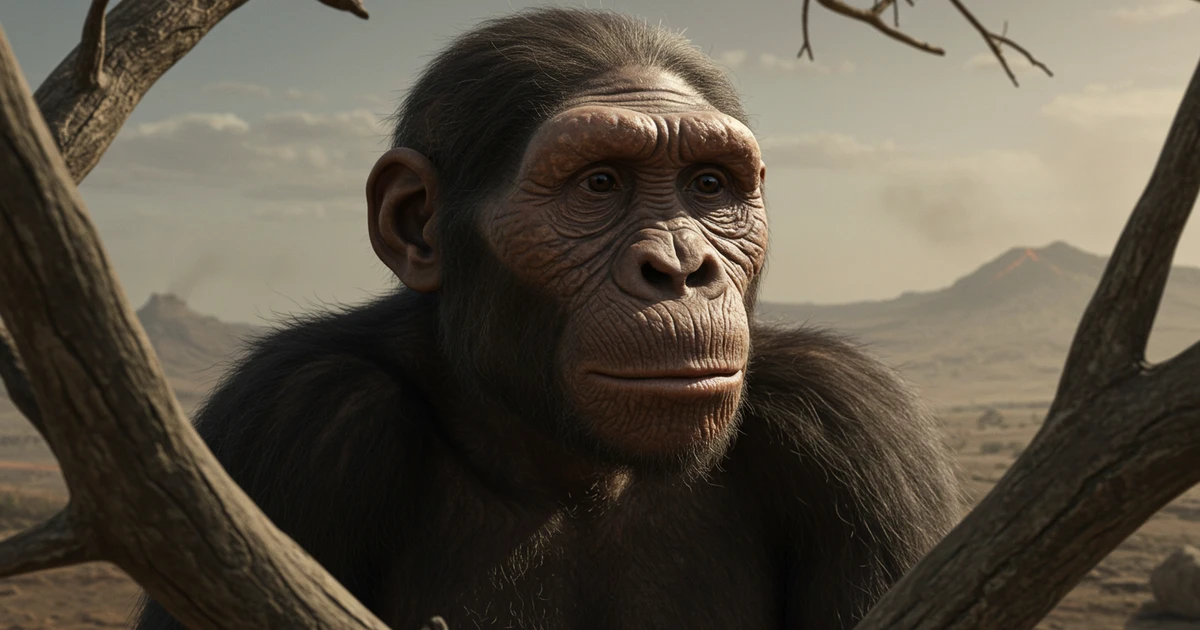
Ardipithecus kadabba
Ardipithecus kadabba represents one of the earliest and most enigmatic branches on the human family tree, dating to the Late Miocene, between 5.8 and 5.2 million years ago. Discovered by paleoanthropologist Yohannes Haile-Selassie in the Middle Awash region of Ethiopia beginning in 1997, the fossil evidence is fragmentary but highly significant. It consists primarily of teeth, a mandible fragment (the holotype ALA-VP-2/10), and several postcranial bones from the arm, hand, and foot. The dentition displays a mosaic of traits, including primitive, ape-like canines that still show evidence of honing against the lower third premolar, a feature lost in later hominins, though this complex is functionally reduced compared to non-hominin apes.
The phylogenetic and behavioral implications of Ar. kadabba are profound, placing it near the divergence point of hominins and chimpanzees. A key piece of evidence is a toe bone (proximal phalanx) from the Asa Koma site, which exhibits a dorsal curvature typical of arboreal grasping but also a proximal joint surface that is angled upwards, a clear adaptation for toeing-off during bipedal locomotion. This combination suggests a facultative biped that still spent considerable time in the trees. Paleoenvironmental reconstructions indicate that Ar. kadabba inhabited a mosaic of woodlands, floodplains, and forests, challenging the classic savanna hypothesis which posited open grasslands as the primary driver for the evolution of bipedalism.
Attributes
| Year Discovered | 1997 |
|---|---|
| Cranial Capacity | Unknown (no cranial fossils) cc |
| Estimated Stature | Unknown (fragmentary postcrania) m |
| Type Specimen | ALA-VP-2/10 |
| Evolutionary Group | Early Hominin |
| Associated Tools | None |
| Chronological Range | 5.8 - 5.2 Mya Mya |
| Extinction Context | Likely represents an ancestral chronospecies that evolved into Ardipithecus ramidus. |