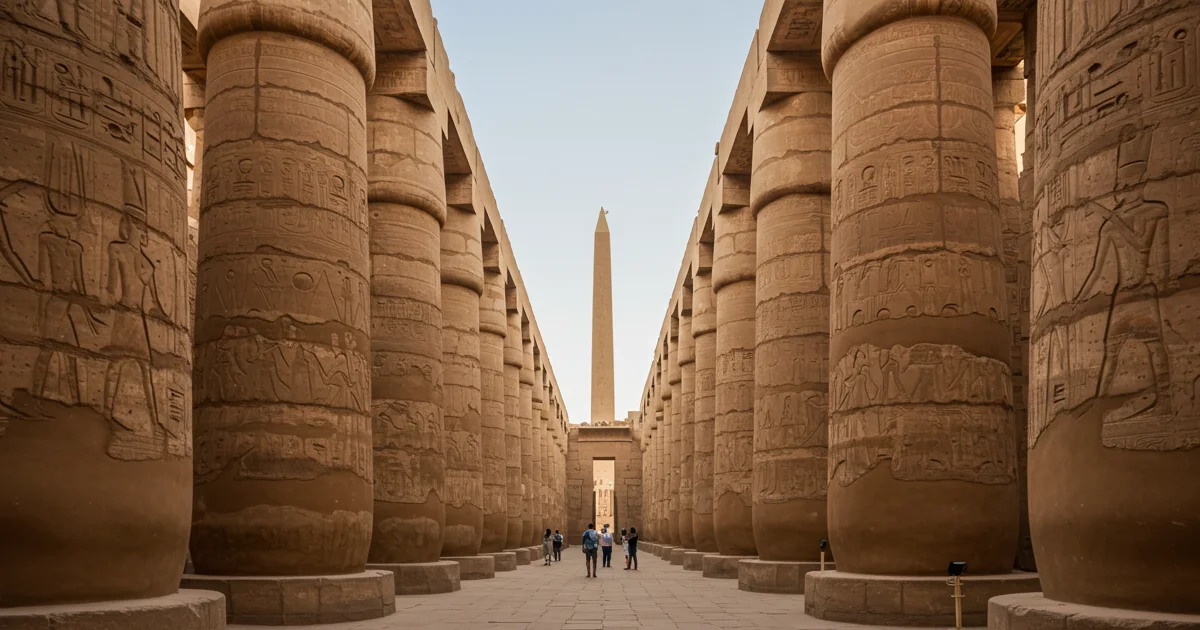
Ancient Thebes: A Monumental Legacy
Ancient Thebes, spanning both banks of the Nile, served as the religious capital of New Kingdom Egypt, embodying the zenith of pharaonic power and spiritual devotion. On the East Bank, the colossal Karnak Temple Complex, dedicated primarily to Amun-Re, covers over 100 hectares, featuring the Great Hypostyle Hall with 134 massive columns, some reaching 21 meters in height, and numerous pylons, obelisks, and sanctuaries. Adjacent to it, Luxor Temple, connected by an avenue of sphinxes, showcases grand colonnades and courtyards, reflecting the architectural grandeur and religious rituals central to the New Kingdom's imperial cult.
Across the Nile on the West Bank lies the vast Theban Necropolis, a landscape dominated by royal tombs and mortuary temples. This includes the Valley of the Kings, where pharaohs like Tutankhamun and Ramesses II were interred in elaborate rock-cut tombs adorned with intricate hieroglyphs and vibrant paintings detailing their journey to the afterlife. Nearby, the Mortuary Temple of Hatshepsut, a stunning example of terraced architecture carved into the cliffs, and the colossal statues of Amenhotep III, known as the Colossi of Memnon, stand as enduring testaments to the sophisticated engineering and profound belief systems of ancient Egyptian civilization.
Attributes
| Year Inscribed | 1979 |
|---|---|
| Property Area | 7390 ha |
| Buffer Zone | 444 ha |
| UNESCO ID | 87 |
| Category Type | Cultural |
| Primary Material | Sandstone & Limestone |
| Epoch Origin | New Kingdom Era (16th C. BCE) |
| Conservation Status | Active Monitoring |
| Annual Visitors | 2 million |