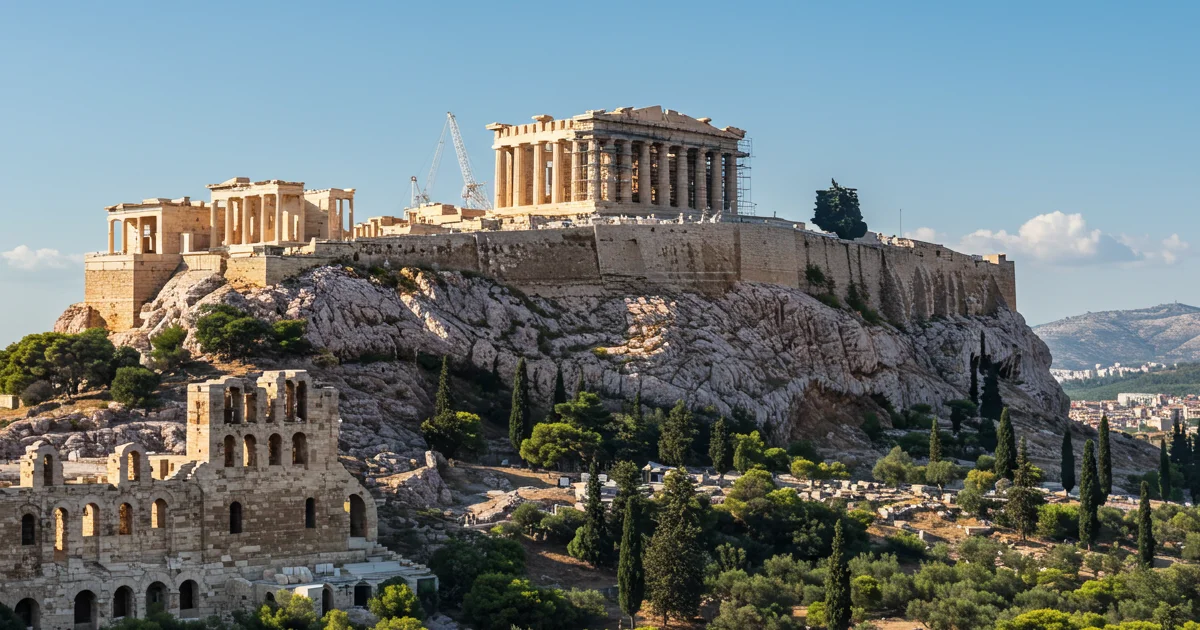
Symbol of Classical Antiquity
The Acropolis of Athens is dominated by the Parthenon, a Doric temple dedicated to the goddess Athena, measuring approximately 69.5 meters in length and 30.9 meters in width. Constructed from Pentelic marble between 447 and 438 BCE, it features an octastyle façade and elaborate sculptural decoration, including the iconic frieze depicting the Panathenaic procession, metopes illustrating mythological battles, and pedimental sculptures. Other significant structures include the Propylaea, the monumental entrance gate, and the Erechtheion, an Ionic temple renowned for its distinctive Porch of the Caryatids.
Historically, the Acropolis served as a fortified citadel and a sacred sanctuary, embodying the political and cultural zenith of ancient Athens during the Golden Age of Pericles. Its architectural program, overseen by Phidias, was a deliberate expression of Athenian power, piety, and artistic excellence. Over centuries, it has witnessed transformations, serving as a Byzantine church, a Frankish fortress, and an Ottoman mosque, yet its classical integrity and symbolic value as the birthplace of democracy and Western civilization remain paramount, making it a cornerstone of global cultural heritage.
Attributes
| Year Inscribed | 1987 |
|---|---|
| Property Area | 304 ha |
| Buffer Zone | 0 ha |
| UNESCO ID | 404 |
| Category Type | Cultural |
| Primary Material | Pentelic Marble |
| Epoch Origin | Classical Antiquity (5th C. BCE) |
| Conservation Status | Excellent |
| Annual Visitors | 3.5 million |